Miranda warning
The Dark HalfThe Miranda warning is the formal notice Alan Pangborn gives Thad Beaumont before questioning him about a capital crime. In the Beaumont home, its measured recital turns a confused confrontation into a police procedure, but the apparent match between Thad’s fingerprints and evidence connected to a murder makes the warning an early sign of how difficult it will be to separate legal proof from the story’s unsettling anomalies.
The warning at the Beaumont home
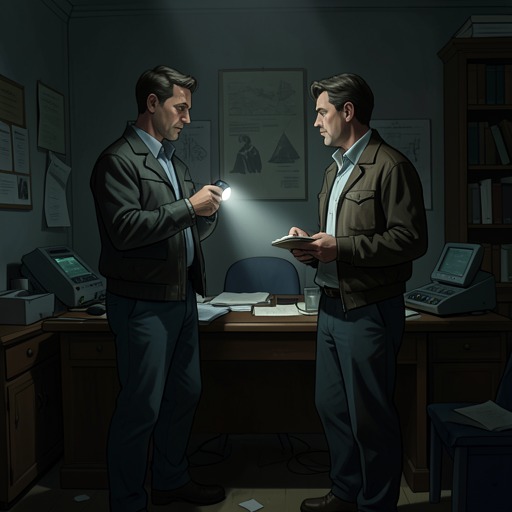
Pangborn arrives in a waterproof jacket, takes a card from his back pocket, and reads from it. Thad recognizes that he is hearing a version of the Miranda warning. Pangborn identifies himself as sheriff of Castle County, Maine, says he must question Thad in connection with a capital crime, and specifies that the questioning will take place at the Orono State Police Barracks. He tells Thad that he has the right to remain silent and the right to legal counsel, with counsel provided if Thad cannot afford it.
The card gives the encounter a clear legal frame, but not an explanation Thad can accept. Liz asks what is happening, and Thad objects that he has no idea what the situation is. He insists that he will not go with Pangborn until he knows why, even if that means Pangborn must obtain an arrest warrant. Thad says he has done nothing; his anger rises as he challenges the sheriff’s presence far from his territory and rejects the implication that he should simply submit to questioning.
Why Thad is a suspect
Pangborn explains that the inquiry concerns Homer Gamache’s murder. Homer was killed between one and three in the morning on June 1, and the murder weapon was his own prosthetic arm. His pickup truck was found at an Interstate 95 rest stop in Connecticut, near the New York border. Investigators found numerous fingerprints in the truck, including several attributed to the perpetrator; one was left in blood on the rearview mirror.
The decisive complication is the identification of those prints. When they were entered into the graphics computer used by Armed Services Records and Identification, the result matched Thad’s service record and fingerprints. The warning therefore precedes questioning under a grave suspicion that seems to have a physical basis. Liz challenges the implication that Thad could be responsible, while Thad focuses on whether the apparent fingerprint evidence is as straightforward as it looks.
Procedure and evidentiary doubt
Thad asks whether fingerprints require a minimum number of comparison points before they can be admitted as evidence. Pangborn answers that Maine requires six perfect comparisons. Thad’s question is pointed: his research for the Stark novels has given him some knowledge of fingerprint evidence, and he wonders whether the quality of the prints itself should raise suspicion. The scene distinguishes the official act of identifying a match from the further question of how that match came to exist.
Pangborn later says he believes Thad was speaking truthfully, drawing on his experience as a police officer, but that judgment does not make the prints disappear. Nor does it settle the tension between the formal procedure and the extraordinary evidence that accumulates around the case. When Pangborn hears that the words HIGH-TONED SON OF A BITCH have appeared, he tells himself the report proves nothing supernatural; yet he also recalls the voice-print results, the fingerprints, and the sparrows that crashed into the windows of Bergenfield County Hospital. The case thus keeps pressing beyond what ordinary police explanation can comfortably contain.
Narrative significance
The warning is both a legal safeguard and a threshold into the investigation. Pangborn’s recitation makes the stakes explicit before the evidence has been explained, while Thad’s resistance shows that the procedure cannot answer the central question of his involvement. The fingerprint match gives the suspicion a concrete form; Thad’s challenge about comparison standards directs attention to the reliability and provenance of that evidence.
As the investigation proceeds, fingerprints and voice prints become part of a widening pattern rather than isolated forensic findings. The warning’s orderly language stands against that pattern: the authorities can name the crime, state the rights, and identify a suspect, but the evidence increasingly points toward a reality their ordinary categories struggle to contain.